


Companies are asking how to build specialized AI that fits with the way their workflows actually run.
The first wave of enterprise AI was about access. Companies experimented with new frontier and open models, ran pilots and explored how AI can help.
Now, specialized agents — systems of models that can reason, use tools and take action even for the most complex workflows — put more useful AI within reach of the people who already know the work best.
Agents are already helping life sciences researchers accelerate medicine discovery, security teams investigate vulnerabilities with more context and operations teams seamlessly coordinate supply chains.
To tap into these specialized agents, businesses are using a foundation they can adapt and own: one built on models they can customize, tools that connect to systems they already use and infrastructure that lets agents operate safely at scale.
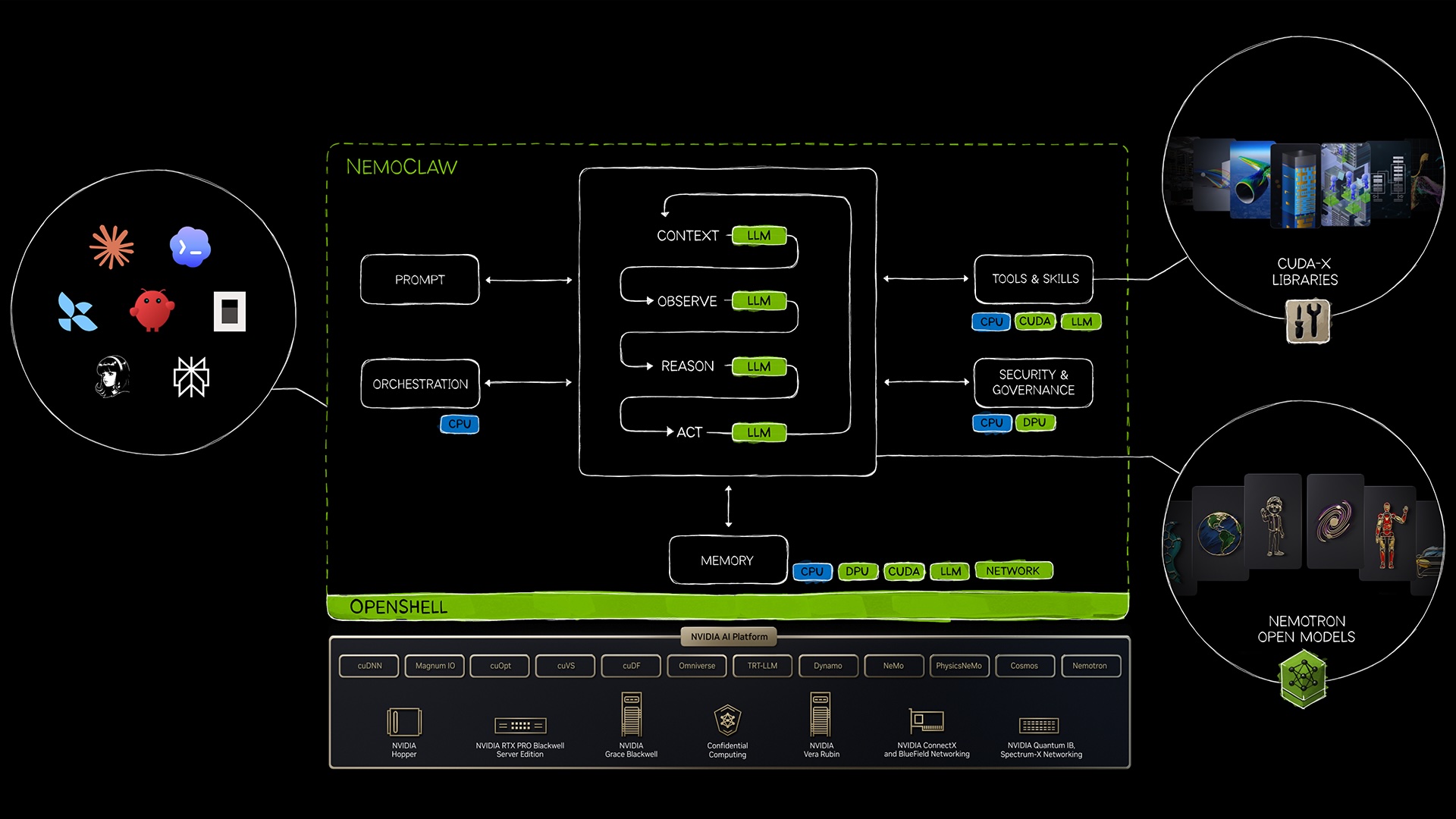
NVIDIA Agent Toolkit — comprising models, tools, skills and a secure runtime — provides an open, modular foundation for building safer, faster, lower-cost digital AI coworkers that enterprises and developers can customize, specialize, control and trust.
The Building Blocks for Specialized AI Coworkers
Enterprises and developers building secure, specialized AI agents require:
- Models, which provide the reasoning foundation.
- Tools and skills, which connect agents to the actions and domain expertise needed to get work done.
- Runtime support, which helps agents execute workflows.
NVIDIA Agent Toolkit includes all three:
- NVIDIA Nemotron open models give teams flexibility to customize, evaluate and deploy agents for their own needs.
- NVIDIA NemoClaw blueprints provide patterns for safer agent behavior, delivering accurate results at lower costs, with tools and skills connecting agents to concrete actions.
- The NVIDIA OpenShell runtime helps agents operate safely inside the systems where work gets done.
NVIDIA technologies accelerate all the pieces needed to turn a powerful frontier model into a fully functional digital coworker. The toolkit’s users can work with third-party agent harnesses — or agent orchestration frameworks — of their choice, including Hermes Agents and OpenClaw.

This unlocks enterprise AI momentum with control. And that matters because the most valuable agents across industries will be specialized.
Agents Take Shape Across Industries
The specialized AI foundation is already at work.
In life sciences, agents can help researchers call domain models for protein design, virtual screening, genomics analysis and biomarker discovery. The new NVIDIA BioNeMo Toolkit enables work that previously took months to be completed in days.
In healthcare, agents support clinical documentation, clinical decision support and care coordination. Plus, physical agents in robotics systems trained in digital twins of hospitals can scale surgical assistance and hospital automation to meet care demands.
In software, cybersecurity, industrial operations and customer workflows, agents can connect to the tools and data teams already use, helping people move faster through complex workflows.
For example, Cadence and Synopsys are building autonomous agents for chip design and engineering workflows. CrowdStrike is running specialized security agents that triage alerts with 98.5% accuracy. Palantir, SAP, ServiceNow, Siemens and Dassault Systèmes are embedding agent capabilities into the enterprise platforms where critical decisions get made.
It all points to the same larger shift: Agents become more useful when they can combine models, tools, skills, runtime and infrastructure in ways companies can adapt to their own workflows. NVIDIA Agent Toolkit provides an open, modular foundation that enables this combination.
Learn more about NVIDIA Agent Toolkit and NVIDIA BioNeMo Agent Toolkit.