

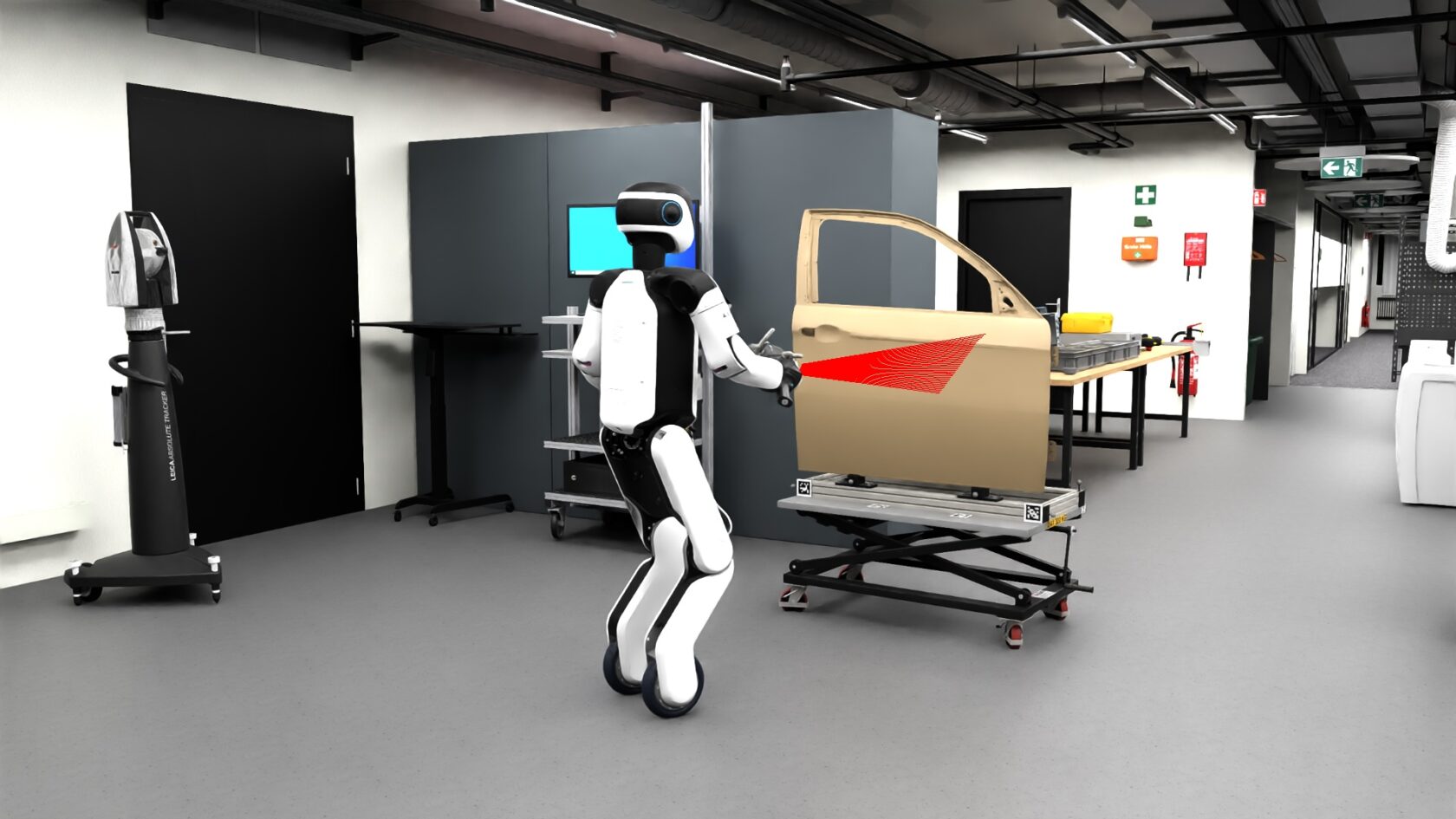
As a global labor shortage leaves 50 million positions unfilled across industries like manufacturing and logistics, Hexagon — a global leader in measurement technologies — is developing humanoid robots that can lend a helping hand.
Industrial sectors depend on skilled workers to perform a variety of error-prone tasks, including operating high-precision scanners for reality capture — the process of capturing digital data to replicate the real world in simulation.
At the Hexagon LIVE Global conference, Hexagon’s robotics division today unveiled AEON — a new humanoid robot built in collaboration with NVIDIA that’s engineered to perform a wide range of industrial applications, from manipulation and asset inspection to reality capture and operator support. Hexagon plans to deploy AEON across automotive, transportation, aerospace, manufacturing, warehousing and logistics.
Future use cases for AEON include:
- Reality capture, which involves automatic planning and then scanning of assets, industrial spaces and environments to generate 3D models. The captured data is then used for advanced visualization and collaboration in the Hexagon Digital Reality (HxDR) platform powering Hexagon Reality Cloud Studio (RCS).
- Manipulation tasks, such as sorting and moving parts in various industrial and manufacturing settings.
- Part inspection, which includes checking parts for defects or ensuring adherence to specifications.
- Industrial operations, including highly dexterous technical tasks like machinery operations, teleoperation and scanning parts using high-end scanners.
“The age of general-purpose robotics has arrived, due to technological advances in simulation and physical AI,” said Deepu Talla, vice president of robotics and edge AI at NVIDIA. “Hexagon’s new AEON humanoid embodies the integration of NVIDIA’s three-computer robotics platform and is making a significant leap forward in addressing industry-critical challenges.”

Using NVIDIA’s Three Computers to Develop AEON
To build AEON, Hexagon used NVIDIA’s three computers for developing and deploying physical AI systems. They include AI supercomputers to train and fine-tune powerful foundation models; the NVIDIA Omniverse platform, running on NVIDIA OVX servers, for testing and optimizing these models in simulation environments using real and physically based synthetic data; and NVIDIA IGX Thor robotic computers to run the models.
Hexagon is exploring using NVIDIA accelerated computing to post-train the NVIDIA Isaac GR00T N1.5 open foundation model to improve robot reasoning and policies, and tapping Isaac GR00T-Mimic to generate vast amounts of synthetic motion data from a few human demonstrations.
AEON learns many of its skills through simulations powered by the NVIDIA Isaac platform. Hexagon uses NVIDIA Isaac Sim, a reference robotic simulation application built on Omniverse, to simulate complex robot actions like navigation, locomotion and manipulation. These skills are then refined using reinforcement learning in NVIDIA Isaac Lab, an open-source framework for robot learning.
This simulation-first approach enabled Hexagon to fast-track its robotic development, allowing AEON to master core locomotion skills in just 2-3 weeks — rather than 5-6 months — before real-world deployment.
In addition, AEON taps into NVIDIA Jetson Orin onboard computers to autonomously move, navigate and perform its tasks in real time, enhancing its speed and accuracy while operating in complex and dynamic environments. Hexagon is also planning to upgrade AEON with NVIDIA IGX Thor to enable functional safety for collaborative operation.
“Our goal with AEON was to design an intelligent, autonomous humanoid that addresses the real-world challenges industrial leaders have shared with us over the past months,” said Arnaud Robert, president of Hexagon’s robotics division. “By leveraging NVIDIA’s full-stack robotics and simulation platforms, we were able to deliver a best-in-class humanoid that combines advanced mechatronics, multimodal sensor fusion and real-time AI.”
Data Comes to Life Through Reality Capture and Omniverse Integration
AEON will be piloted in factories and warehouses to scan everything from small precision parts and automotive components to large assembly lines and storage areas.

Captured data comes to life in RCS, a platform that allows users to collaborate, visualize and share reality-capture data by tapping into HxDR and NVIDIA Omniverse running in the cloud. This removes the constraint of local infrastructure.
“Digital twins offer clear advantages, but adoption has been challenging in several industries,” said Lucas Heinzle, vice president of research and development at Hexagon’s robotics division. “AEON’s sophisticated sensor suite enables the integration of reality data capture with NVIDIA Omniverse, streamlining workflows for our customers and moving us closer to making digital twins a mainstream tool for collaboration and innovation.”
AEON’s Next Steps
By adopting the OpenUSD framework and developing on Omniverse, Hexagon can generate high-fidelity digital twins from scanned data — establishing a data flywheel to continuously train AEON.
This latest work with Hexagon is helping shape the future of physical AI — delivering scalable, efficient solutions to address the challenges faced by industries that depend on capturing real-world data.
Watch the Hexagon LIVE keynote, explore presentations and read more about AEON.
All imagery courtesy of Hexagon.