

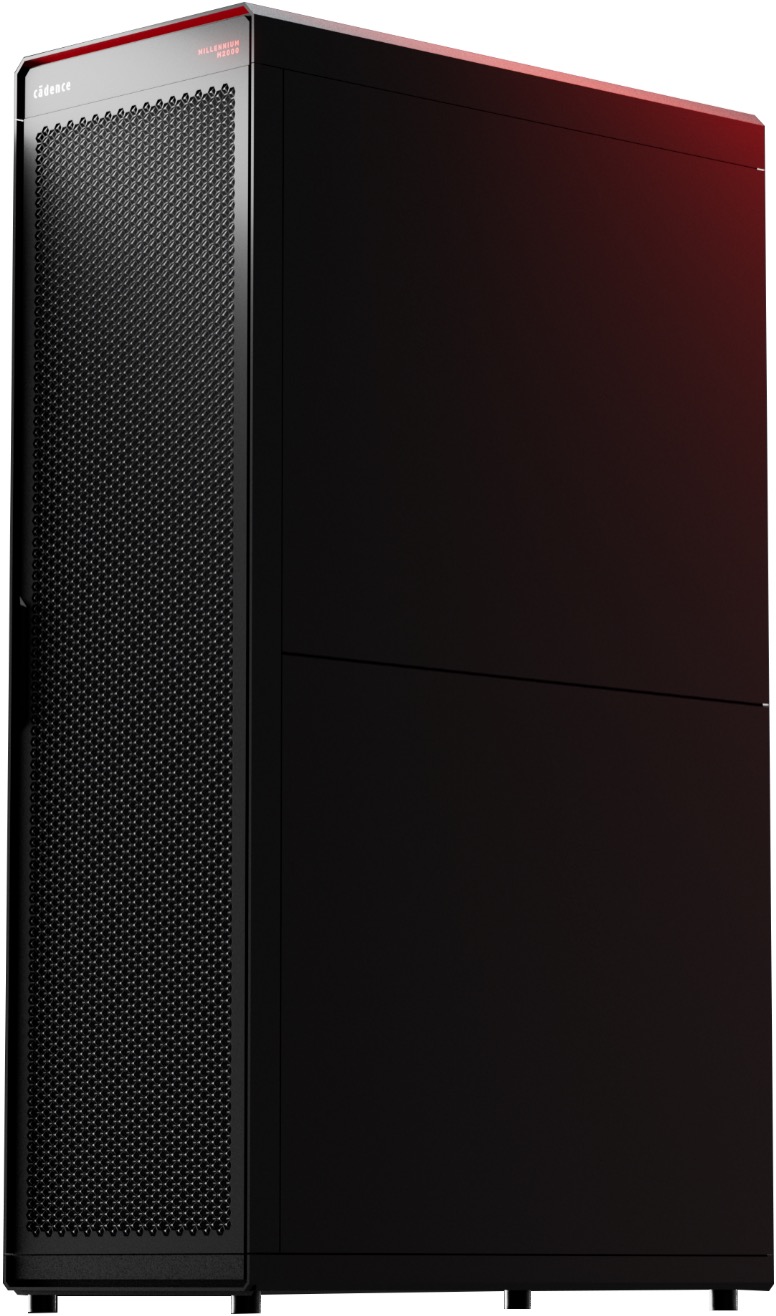
A new supercomputer offered by Cadence, a leading provider of technology for electronic design automation, is poised to support a suite of engineering design and life sciences applications accelerated by NVIDIA Blackwell systems and NVIDIA CUDA-X software libraries.
Available to deploy in the cloud and on premises, the Millennium M2000 Supercomputer features NVIDIA HGX B200 systems and NVIDIA RTX PRO 6000 Blackwell Server Edition GPUs. Combined with optimized software, the supercomputer delivers up to 80x higher performance for electronic design automation, system design and life sciences workloads compared to its predecessor, a CPU-based system.
With this boost in computational capability, engineers can run massive simulations to drive breakthroughs in the design and development of autonomous machines, drug molecules, semiconductors, data centers and more.
Anirudh Devgan, president and CEO of Cadence, discussed the collaboration with NVIDIA founder and CEO Jensen Huang onstage at CadenceLIVE, taking place today in Santa Clara, California.
“This is years in the making,” Devgan said during the conversation with Huang. “It’s a combination of advancement on the hardware and system side by NVIDIA — and then, of course, we have to rewrite our software to take advantage of that.”
The pair discussed how NVIDIA and Cadence are working together on AI factories, digital twins and agentic AI.
“The work that we’re doing together recognizes that there’s a whole new type of factory that’s necessary. We call them AI factories,” Huang said. “AI is going to infuse into every single aspect of everything we do. Every company will be run better because of AI, or they’ll build better products because of AI.”
Huang also announced that NVIDIA plans to purchase 10 Millennium Supercomputer systems based on the NVIDIA GB200 NVL72 platform to accelerate the company’s chip design workflows.
“This is a big deal for us,” he said. “We started building our data center to get ready for it.”
Enabling Intelligent Design Across Industries
The Millennium Supercomputer harnesses accelerated software from NVIDIA and Cadence for applications including circuit simulation, computational fluid dynamics, data center design and molecular design.

With the supercomputer’s optimized hardware and AI software, engineers and researchers can build more complex, detailed simulations that are capable of delivering more accurate insights to enable faster silicon, systems and drug development.
Through this collaboration, Cadence and NVIDIA are solving key design challenges with diverse applications across industries — for example, simulating thermal dynamics for chip design, fluid dynamics for aerospace applications and molecular dynamics for pharmaceutical research.
NVIDIA engineering teams used Cadence Palladium emulation platforms and Protium prototyping platforms to support design verification and chip bring-up workflows for the development of NVIDIA Blackwell.
Cadence used NVIDIA Grace Blackwell-accelerated systems to calculate the fluid dynamics at work when an aircraft takes off and lands. Using NVIDIA GB200 Grace Blackwell Superchips and the Cadence Fidelity CFD Platform, Cadence was able to run in under 24 hours highly complex simulations that would take several days to complete on a CPU cluster with hundreds of thousands of cores.
Cadence also used NVIDIA Omniverse application programming interfaces to visualize these intricate fluid dynamics.

The company has integrated NVIDIA BioNeMo NIM microservices into Orion, Cadence’s molecular design platform — and NVIDIA Llama Nemotron reasoning models into the Cadence JedAI Platform.
Cadence has also adopted the NVIDIA Omniverse Blueprint for AI factory digital twins. Connected to the Cadence Reality Digital Twin Platform, the blueprint enables engineering teams to test and optimize power, cooling and networking in an AI factory with physically based simulations — long before construction starts in the real world. With these capabilities, engineers can make faster configuration decisions and future-proof the next generation of AI factories.
Learn more about the collaboration between NVIDIA and Cadence and watch this NVIDIA GTC session on advancing physics-based simulation technology for AI factory design.
Images courtesy of Cadence.