


To help mitigate climate change — one of humanity’s greatest challenges — researchers are turning to AI and sustainable computing to accelerate and operationalize their work.
At this week’s NVIDIA GTC global AI conference, startups, enterprises and scientists are highlighting their environmental sustainability initiatives and latest climate innovations. Many are using NVIDIA Earth-2, a full-stack, open platform for accelerating climate and weather simulation and predictions.
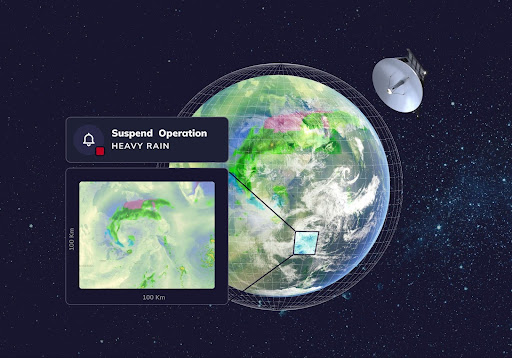
Earth-2 comprises GPU-accelerated numerical weather and climate prediction models, including ICON and IFS; state-of-the-art AI-driven weather models, such as FourCastNet, GraphCast and Deep Learning Weather Prediction, offered through the NVIDIA Modulus framework; and large-scale, interactive, high-resolution data visualization and simulation enabled by the NVIDIA Omniverse platform. These capabilities are also available via cloud APIs, or application programming interfaces.
Various members of NVIDIA Inception — a free, global program for cutting-edge startups — are pioneering climate AI advancements with Earth-2. It’s critical work, as extreme-weather events are expected to take a million lives and cost $1.7 trillion per year by 2050.
Tomorrow.io Powers Weather Predictions of Tomorrow

Boston-based Tomorrow.io provides actionable, weather-related insights to countries, businesses and individuals by applying advanced AI and machine learning models to a proprietary global dataset collected from satellites, radar and other sensors. Its weather intelligence and climate adaptation platform delivers high-resolution, accurate weather forecasts across time zones for both short- and long-term projections.
The startup is using Earth-2 to study the potential impacts of its suite of satellites on global model forecasts. By conducting observing-system simulation experiments, or OSSEs, with Earth-2 AI forecast models, Tomorrow.io can identify the optimal configurations of satellites and other instruments to improve weather-forecasting conditions. The work ultimately aims to offer users precision and simplicity, helping them easily understand complex weather situations and make the right operational decisions at the right time.
Learn more about Tomorrow.io’s work with Earth-2 by joining the GTC session, “Global Strategies: Startups, Venture Capital, and Climate Change Solutions,” taking place today, March 19, at 3 p.m. PT, at the San Jose Convention Center and online.
ClimaSens Advances Flood-Risk Management With AI
ClimaSens, based in Melbourne, Australia, and New York, fuses historical, real-time and future climate and weather information using advanced AI models. FloodSens, its upcoming flood risk analysis model, informs clients about the probability of flooding from rainfall, offering high-resolution assessments of flash flooding, riverine flooding and all types of flooding in between.

FloodSens, now in beta, was developed using Earth-2 APIs and the FourCastNet model for high-fidelity, physically accurate representations of future weather conditions, as well as an ensemble of other models for assessing the probabilities of low-likelihood, high-impact flooding events. Through this work, the startup aims to enable a more resilient, sustainable future for communities worldwide.
North.io Garners Ocean Insights With AI and Accelerated Modeling
 Based in Kiel, Germany, north.io is helping to map the Earth’s largest carbon sink: oceans. Only about 25% of the ocean floor — a critical source of the world’s renewable energy and food security — has been mapped so far.
North.io is collecting and analyzing massive amounts of data from autonomous underwater vehicles (AUVs) and making it accessible, shareable, visualizable and understandable for users across the globe through its TrueOcean platform.
Using Earth-2 APIs, north.io is developing AI weather forecasts for intelligent operational planning, system management and risk assessment for its AUVs. The combination of high-precision weather modeling and the use of autonomous systems drastically reduces human safety risks in rough, offshore environments.
Learn more about the latest AI, high performance computing and sustainable computing advancements for climate research at GTC, running through Thursday, March 21.