

3D Artist and Educator Hsin-Chien Huang Takes VR to the World Stage This Week ‘In the NVIDIA Studio’
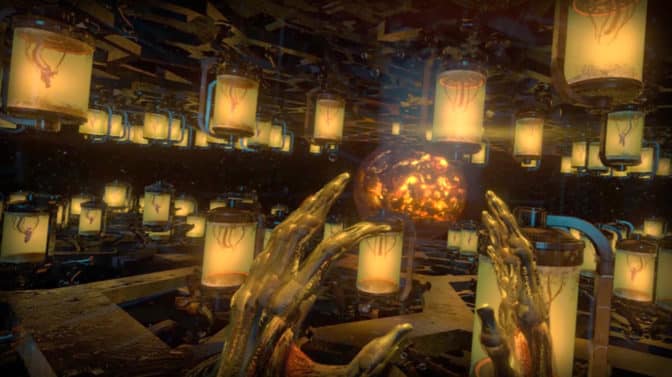
3D artist, virtual reality expert, storyteller and educator Hsin-Chien Huang shares his unique creator journey and award-winning artwork Samsara this week In the NVIDIA Studio.
A Journey Unlike Any Other
Huang is a distinguished professor in the Department of Design at National Taiwan Normal University.
His creative journey included overcoming a number of obstacles, starting at age 4, when he lost sight in his right eye. His eyesight was impaired for over a decade before he regained it thanks to a Sri Lankan cornea donor.
This singular event proved inspirational, cementing virtual reality as his primary creative field, as it allows him to share with others the world as he uniquely sees it.
When he was getting his driver’s license, Huang registered himself as an organ donor, imagining that the cornea in his right eye will continue its journey to others who may receive it after his death.

In Samsara, one’s consciousness can travel within different individuals and animals.
Color, materials, sound and music are critical story elements that drive the narratives of his artwork, Huang said.

“Discussing with musicians about adding sound to works always brings me new ideas to revise stories,” he said. “Elements may influence one another, and the process is like an upward spiral where each element develops and fosters each other simultaneously, slowly shaping the story.”
Cool, But How?
Working in VR can often be a nonlinear experience. Huang spends considerable time prototyping and iterating ideas to ensure that they’re feasible and can be shared.
He and his team will program and create multiple 3D animations and interactions. This helps them to examine if their works can convey the exact concept, invoking the body of emotions they hoped for.

The team makes use of various parametric modeling tools in Autodesk Maya, Houdini, iClone and Unity. The key in setting up 3D geometric objects is that shapes can be changed once parameters such as dimensions or curvatures are modified — removing the need to reshape the model from scratch.
This saves artists lots of time — especially in the conceptual stage — and is critical to the team’s workflow, Huang said.
“We use Unity for integration and interaction, and Xsens and Vicon for motion capture,” he said. Unity’s light baking and Autodesk Maya’s Arnold renderer both require powerful GPUs, and his GeForce RTX 3070 GPU was equal to the task.
The team’s photogrammetry software in RealityCapture also benefits greatly from NVIDIA CUDA acceleration.

“Nowadays, a powerful GeForce RTX GPU is an indispensable tool for digital artists.” — Hsin-Chien Huang
“Although the resolutions of these scanned models are low, it has the aesthetic of pixel art,” Huang said. He processed these models in Unity to give them a unique digital style. NVIDIA DLSS technology powered by his GeForce RTX GPU increases the interactivity of the viewport by using AI to upscale frames rendered at lower resolution while still retaining high-fidelity detail.
When it comes to creating textures, Huang recommends Adobe Substance 3D Painter, which can rapidly create quality, realistic textures for prototyping. RTX-accelerated light and ambient occlusion baking optimize his assets in mere seconds.

Huang also uses Topaz Labs Gigapixel AI, which uses deep learning to offer better photo quality. Yet again his RTX GPU acccelerates AI for the sharpening of images while retaining high-fidelity details.
Huang is grateful for advancements in technology and their impact on creative possibilities.
“Nowadays, a powerful GeForce RTX GPU is an indispensable tool for digital artists,” he said.
Huang’s increasing popularity and extraordinary talent led him to Hollywood. In 2018, Huang performed a VR demo on hit TV show America’s Got Talent, which left an enormous impression on the judges and audience.
It was the first real-time motion capture and VR experience to be presented on a live stage. Huang said the pressure was intense during his performance as it was a live show and no mistakes could be tolerated.
“I could still sense the thrill and excitement on stage,” he recalled.

Check out more of Huang’s artwork on his website.
Carry on, Carry on #WinterArtChallenge
Enter NVIDIA Studio’s #WinterArtChallenge, running through the end of the year, by sharing winter-themed art on Instagram, Twitter or Facebook for a chance to be featured on our social media channels.
Like @RippaSats and his fun celebration of penguins.
Here is another for #WinterArtChallenge
Penguins on a Berg
By: Me pic.twitter.com/pIS2lpi5zq— RippaSats.og (@RippaSats) November 4, 2022
Be sure to tag #WinterArtChallenge to join.
Get creativity-inspiring updates directly to your inbox by subscribing to the NVIDIA Studio newsletter.
The post 3D Artist and Educator Hsin-Chien Huang Takes VR to the World Stage This Week ‘In the NVIDIA Studio’ appeared first on NVIDIA Blog.