

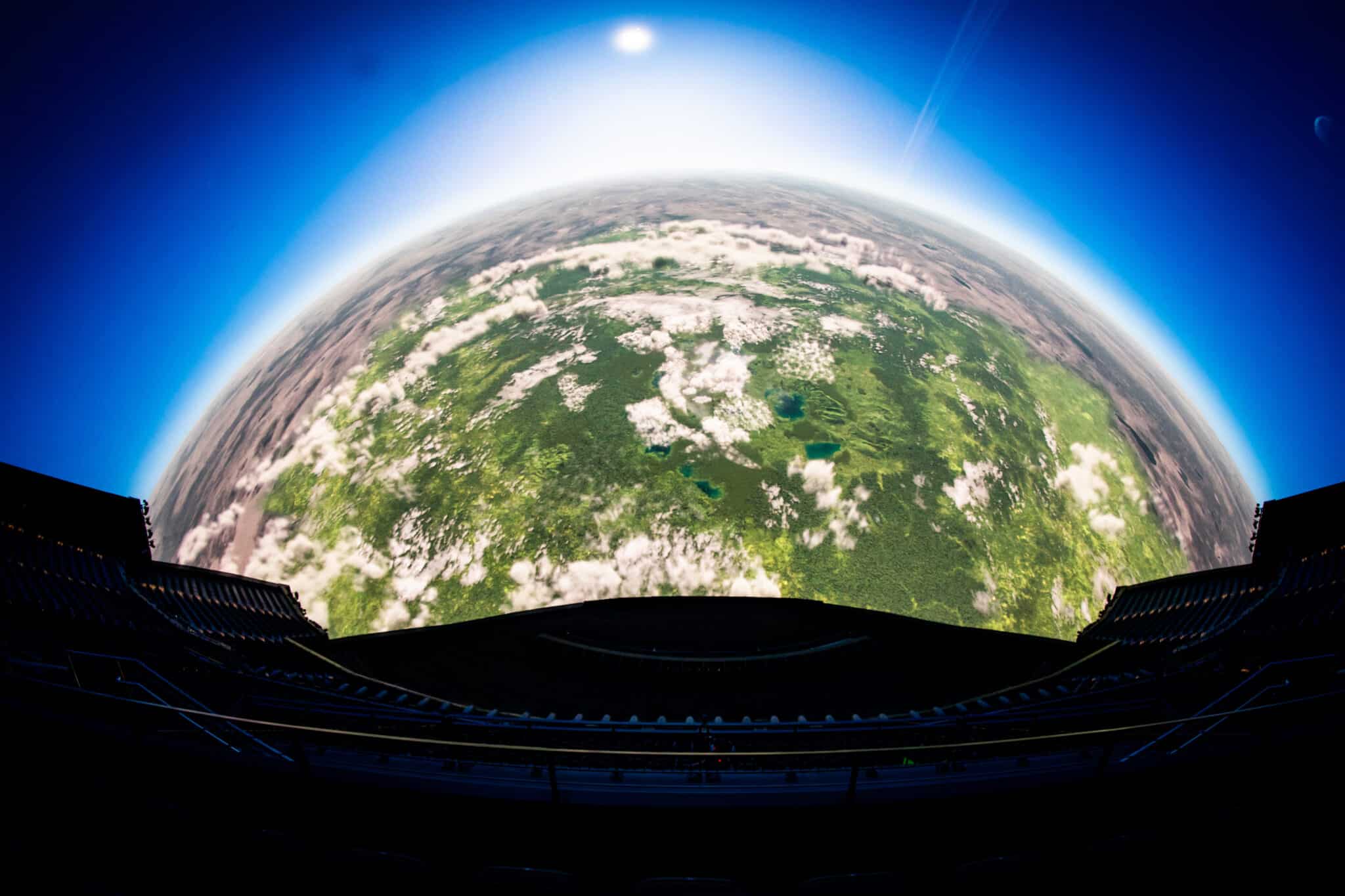
Sphere, a new kind of entertainment medium in Las Vegas, is joining the ranks of legendary circular performance spaces such as the Roman Colosseum and Shakespeare’s Globe Theater — captivating audiences with eye-popping LED displays that cover nearly 750,000 square feet inside and outside the venue.
Behind the screens, around 150 NVIDIA RTX A6000 GPUs help power stunning visuals on floor-to-ceiling, 16x16K displays across the Sphere’s interior, as well as 1.2 million programmable LED pucks on the venue’s exterior — the Exosphere, which is the world’s largest LED screen.
Delivering robust network connectivity, NVIDIA BlueField DPUs and NVIDIA ConnectX-6 Dx NICs — along with the NVIDIA DOCA Firefly Service and NVIDIA Rivermax software for media streaming — ensure that all the display panels act as one synchronized canvas.
“Sphere is captivating audiences not only in Las Vegas, but also around the world on social media, with immersive LED content delivered at a scale and clarity that has never been done before,” said Alex Luthwaite, senior vice president of show systems technology at Sphere Entertainment. “This would not be possible without the expertise and innovation of companies such as NVIDIA that are critical to helping power our vision, working closely with our team to redefine what is possible with cutting-edge display technology.”
Named one of TIME’s Best Inventions of 2023, Sphere hosts original Sphere Experiences, concerts and residencies from the world’s biggest artists, and premier marquee and corporate events.
Rock band U2 opened Sphere with a 40-show run that concluded in March. Other shows include The Sphere Experience featuring Darren Aronofsky’s Postcard From Earth, a specially created multisensory cinematic experience that showcases all of the venue’s immersive technologies, including high-resolution visuals, advanced concert-grade sound, haptic seats and atmospheric effects such as wind and scents.

Behind the Screens: Visual Technology Fueling the Sphere
Sphere Studios creates video content in its Burbank, Calif., facility, then transfers it digitally to Sphere in Las Vegas. The content is then streamed in real time to rack-mounted workstations equipped with NVIDIA RTX A6000 GPUs, achieving unprecedented performance capable of delivering three layers of 16K resolution at 60 frames per second.
The NVIDIA Rivermax software helps provide media streaming acceleration, enabling direct data transfers to and from the GPU. Combined, the software and hardware acceleration eliminates jitter and optimizes latency.
NVIDIA BlueField DPUs also facilitate precision timing through the DOCA Firefly Service, which is used to synchronize clocks in a network with sub-microsecond accuracy.
“The integration of NVIDIA RTX GPUs, BlueField DPUs and Rivermax software creates a powerful trifecta of advantages for modern accelerated computing, supporting the unique high-resolution video streams and strict timing requirements needed at Sphere and setting a new standard for media processing capabilities,” said Nir Nitzani, senior product director for networking software at NVIDIA. “This collaboration results in remarkable performance gains, culminating in the extraordinary experiences guests have at Sphere.”
Well-Rounded: From Simulation to Sphere Stage
To create new immersive content exclusively for Sphere, Sphere Entertainment launched Sphere Studios, which is dedicated to developing the next generation of original immersive entertainment. The Burbank campus consists of numerous development facilities, including a quarter-sized version of Sphere screen in Las Vegas, dubbed Big Dome, which serves as a specialized screening, production facility and lab for content.

Sphere Studios also developed the Big Sky camera system, which captures uncompressed, 18K images from a single camera, so that the studio can film content for Sphere without needing to stitch multiple camera feeds together. The studio’s custom image processing software runs on Lenovo servers powered by NVIDIA A40 GPUs.
The A40 GPUs also fuel creative work, including 3D video, virtualization and ray tracing. To develop visuals for different kinds of shows, the team works with apps including Unreal Engine, Unity, Touch Designer and Notch.
For more, explore upcoming sessions in NVIDIA’s room at SIGGRAPH and watch the panel discussion “Immersion in Sphere: Redefining Live Entertainment Experiences” on NVIDIA On-Demand.
All images courtesy of Sphere Entertainment.