

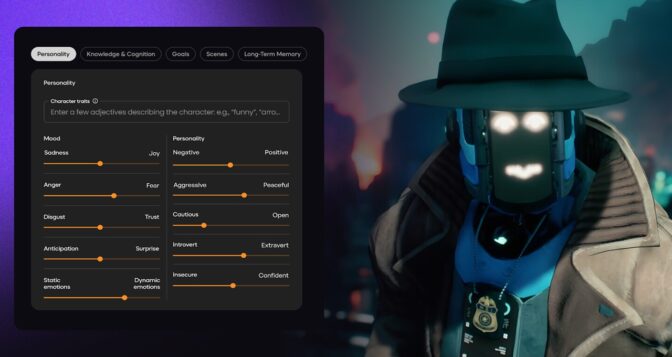
To enhance the gaming experience, studios and developers spend tremendous effort creating photorealistic, immersive in-game environments.
But non-playable characters (NPCs) often get left behind. Many behave in ways that lack depth and realism, making their interactions repetitive and forgettable.
Inworld AI is changing the game by using generative AI to drive NPC behaviors that are dynamic and responsive to player actions. The Mountain View, Calif.-based startup’s Character Engine, which can be used with any character design, is helping studios and developers enhance gameplay and improve player engagement.
Elevate Gaming Experiences: Achievement Unlocked
The Inworld team aims to develop AI-powered NPCs that can learn, adapt and build relationships with players while delivering high-quality performance and maintaining in-game immersion.
To make it easier for developers to integrate AI-based NPCs into their games, Inworld built Character Engine, which uses generative AI running on NVIDIA technology to create immersive, interactive characters. It’s built to be production-ready, scalable and optimized for real-time experiences.
The Character Engine comprises three layers: Character Brain, Contextual Mesh and Real-Time AI.
Character Brain orchestrates a character’s performance by syncing to its multiple personality machine learning models, such as for text-to-speech, automatic speech recognition, emotions, gestures and animations.
The layer also enables AI-based NPCs to learn and adapt, navigate relationships and perform motivated actions. For example, users can create triggers using the “Goals and Action” feature to program NPCs to behave in a certain way in response to a given player input.
Contextual Mesh allows developers to set parameters for content and safety mechanisms, custom knowledge and narrative controls. Game developers can use the “Relationships” feature to create emergent narratives, such that an ally can turn into an enemy or vice versa based on how players treat an NPC.
One big challenge developers face when using generative AI is keeping NPCs in-world and on-message. Inworld’s Contextual Mesh layer helps overcome this hurdle by rendering characters within the logic and fantasy of their worlds, effectively avoiding the hallucinations that commonly appear when using large language models (LLMs).
The Real-Time AI layer ensures optimal performance and scalability for real-time experiences.
Powering Up AI Workflows With NVIDIA
Inworld, a member of the NVIDIA Inception program, which supports startups through every stage of their development, uses NVIDIA A100 Tensor Core GPUs and NVIDIA Triton Inference Server as integral parts of its generative AI training and deployment infrastructure.
Inworld used the open-source NVIDIA Triton Inference Server software to standardize other non-generative machine learning model deployments required to power Character Brain features, such as emotions. The startup also plans to use the open-source NVIDIA TensorRT-LLM library to optimize inference performance. Both NVIDIA Triton Inference Server and TensorRT-LLM are available with the NVIDIA AI Enterprise software platform, which provides security, stability and support for production AI.
Inworld also used NVIDIA A100 GPUs within Slurm-managed bare-metal machines for its production training pipelines. Similar machines wrapped in Kubernetes help manage character interactions during gameplay. This setup delivers real-time generative AI at the lowest possible cost.
“We chose to use NVIDIA A100 GPUs because they provided the best, most cost-efficient option for our machine learning workloads compared to other solutions,” said Igor Poletaev, vice president of AI at Inworld.
“Our customers and partners are looking to find novel and innovative ways to drive player engagement metrics by integrating AI NPC functionalities into their gameplay,” said Poletaev. “There’s no way to achieve real-time performance without hardware accelerators, which is why we required GPUs to be integrated into our backend architecture from the very beginning.”
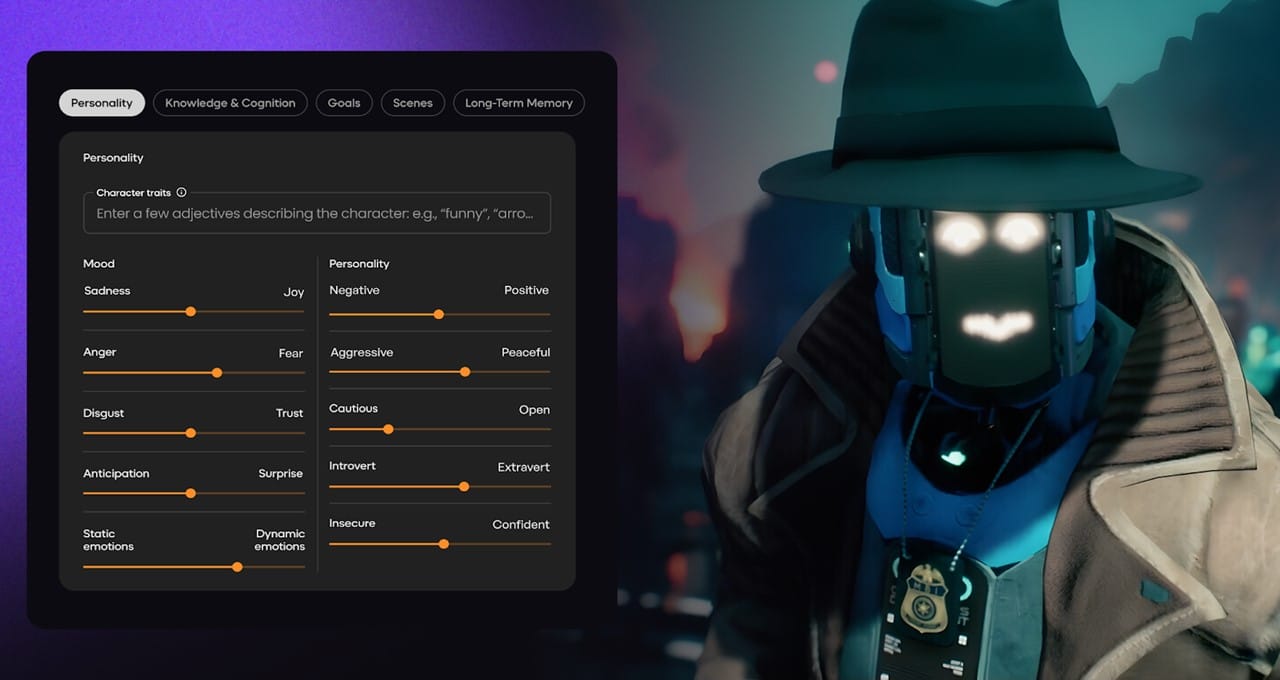
Inworld’s generative AI-powered NPCs have enabled dynamic, evergreen gaming experiences that keep players coming back. Developers and gamers alike have reported enhanced player engagement, satisfaction and retention.
Inworld has powered AI-based NPC experiences from Niantic, LG UPlus, Alpine Electronics and more. One open-world virtual reality game using the Inworld Character Engine saw a 5% increase in playtime, while a detective-themed indie game garnered over $300,000 in free publicity after some of the most popular Twitch streamers discovered it.
Learn more about Inworld AI and NVIDIA technologies for game developers.